HyperLend Review 2026: Complete Beginner's Guide to Lending, Borrowing, HyperLoop and the HPL Token on Hyperliquid
ReviewHyperLend Review 2026 covers lending, borrowing, HyperLoop and the HPL token on Hyperliquid, with beginner-friendly steps and key risks explained.


Who This Guide Is For
This guide is for someone who holds HYPE or a staked version of it and keeps hearing that you can lend it, borrow against it, or "loop" it for extra yield on HyperLend. It is also for a reader who has used a bank loan or a pawn shop and wants to know how the crypto version works and where it can hurt. We explain every term when it first appears. You do not need to know what a health factor, an oracle or a liquidation is before you start.
We also want to be clear about the limit of this review. We connected a real wallet to the live app and opened every public page. The wallet was empty, so we could not put money in, borrow, or take money out. Everything about how a deposit or a loan behaves in practice comes from the app screens, the documentation and public data, not from a transaction we made. We mark that wherever it matters.
How We Tested HyperLend
| Step | What we did | Result |
|---|---|---|
| Read the public site | Opened hyperlend.finance on desktop | Loaded, with headline volume and size figures |
| Open the app | Loaded app.hyperlend.finance | A phishing warning appeared first, then the dashboard |
| Terms | Ticked the two boxes in the Disclaimer window | Accepted, no signature asked |
| Connect a wallet | MetaMask demo wallet through the app's wallet list | Connected, address 0x5363…7A0cD |
| Dashboard | Opened the connected dashboard | Empty, as expected, health factor shown as 10+ |
| Markets | Opened the Crypto Markets table and the USDC Supply window | Loaded, supply window shows 0 suppliable because the wallet is empty |
| Other pages | Stake & Save, HyperLoop, Aviya, Referrals | All loaded. Referrals asks for a signed message, which we declined |
| Deposit, borrow, withdraw | Could not run, the demo wallet holds nothing | Not tested |
| Docs and security | Read docs.hyperlend.finance and the audit list | Reviewed, audit PDFs not opened |
| Public data | DefiLlama, CoinGecko, GitHub | Pulled on November 26, 2026 |
The demo wallet holds no money. We never signed a message and never confirmed a transaction. Ticking a terms box is not a signature, so we did that.
Quick Verdict
HyperLend is a lending market that is native to the Hyperliquid ecosystem, with a clean app and clear documentation. It is also smaller than it was a few months ago, its token is thin and falling, and some of its smaller markets show prices that no sensible user should touch.
| Item | Our view |
|---|---|
| Best for | HYPE holders who want to earn on idle tokens or borrow stablecoins without selling |
| Not for | Anyone who cannot watch a loan, and anyone looking for a safe place for money they cannot afford to lose |
| Ease of use | Good. Clean pages, plain labels, a health factor on every window |
| Transparency | Good on audits and rules, fair on live data, with one size figure that needs explaining |
| Main risk | Smart contract bugs, price swings that trigger liquidation, bad debt in small markets |
| Our editorial score | 7.5 out of 10 |
The score is ours and rests on what we could verify. It would be higher if we had been able to complete a deposit, a loan and a withdrawal with real funds.
What Is HyperLend (Plain English)
Think of a pawn shop that never closes and has no staff. You leave something valuable at the counter and the shop lends you cash worth less than the item. If the item loses value, the shop sells it to protect itself. Meanwhile, other customers can leave cash at the same shop and earn a share of the interest the borrowers pay.
HyperLend is that shop, run by software on the Hyperliquid network. People who supply a token put it into a shared pool and earn interest. People who borrow put up a different token as collateral, which is the item left at the counter, and take a loan from the pool. The interest rate moves up when more of the pool is borrowed and down when less is borrowed.
Four words are worth learning now.
The health factor is a safety score for your loan. Above 1, the loan has not reached the liquidation threshold. At 1 or below, anyone can repay part of your debt and take some of your collateral at a discount, which is called a liquidation. The app shows "10+" when you have no loan, meaning you are very far from danger.
A liquidation penalty is the discount the liquidator gets. It is a cost to the borrower and the reason you should never run a loan close to the line.
An oracle is the service that tells the contracts the price of each token. If the price feed is wrong or late, loans can be liquidated unfairly or bad loans can stay open. HyperLend says it uses Chainlink and RedStone.
HyperEVM is the part of Hyperliquid where ordinary smart contracts run, the same kind of contracts that run on Ethereum. HyperLend lives there. HYPE is the network's native token.
HyperLend is built on the same design family as Aave, the largest lending protocol, which is why the pages, the health factor and the liquidation rules will feel familiar to anyone who has used it.
Key Facts
| Fact | Detail | Source |
|---|---|---|
| What it is | Decentralized lending and borrowing market | HyperLend docs |
| Network | Hyperliquid (HyperEVM) | DefiLlama |
| Main app | app.hyperlend.finance | App |
| Value locked, main pool | About $230.1M | DefiLlama, Nov 26, 2026 |
| Value locked 30 days ago | About $320.8M | DefiLlama |
| Peak value locked | About $671.6M on Sep 12, 2025 | DefiLlama |
| Total borrowed, main pool | About $131.9M | DefiLlama |
| Isolated markets | About $148K locked | DefiLlama |
| Market size shown in app | About $361M supplied, $230.2M available, $131.8M borrowed | App, Markets page |
| Token | HPL, 1 billion maximum supply | CoinGecko |
| Audits | Seven listed, from five firms or contests | HyperLend docs |
| Oracles | Chainlink and RedStone | HyperLend docs |
| Risk partners | Block Analitica, Hypernative, Blockworks Advisory | HyperLend docs |
| Code | github.com/hyperlendx, core repository updated Nov 14, 2026 | GitHub |
Value locked on the main pool has fallen about 28 percent in 30 days and about 66 percent from its peak. That is a large drop and a fair warning that money moves in and out of this protocol quickly.
The App, Page by Page
First load and the phishing warning
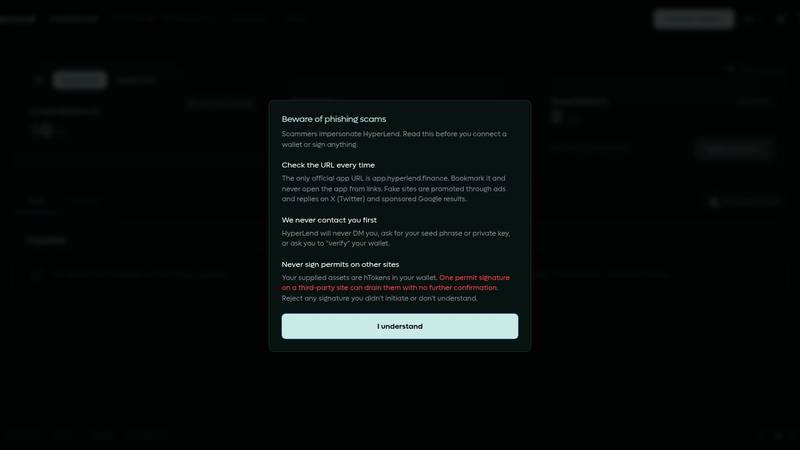
The first thing the app shows is a window headed "Beware of phishing scams". It says the only official address is app.hyperlend.finance and warns that signing a "permit" message can let a thief drain your deposit receipt tokens. We think this is the right way to start. Lending apps are a favorite target for fake sites, and the warning is specific about the trick that actually costs people money.
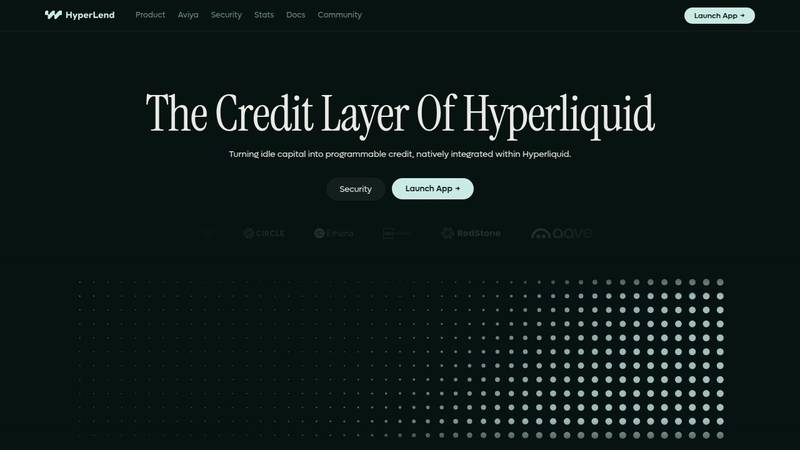
The public landing page leads with large numbers: more than $35 billion in total volume, more than $360 million in market size and more than $131 million borrowed. The second and third match the app. The first is a cumulative figure over the life of the protocol, so it says how much has moved through, not how much is held today.
Connecting a wallet
Pressing Connect Wallet opens a Disclaimer window with two boxes. One says you agree to be legally bound by the Terms, including future changes. The other says the site only shows blockchain data, the operators have no custody of your funds and no power to reverse your transactions, and they do not endorse any token. The Confirm button stays grey until both are ticked. This is a clickwrap agreement, standard for the sector, and worth reading once because it states plainly that nobody can undo a mistake for you.
After that a wallet list opens: WalletConnect, MetaMask, My Wallet, Trust Wallet, Binance Wallet and a search over 570 wallets. MetaMask is marked as installed, and it connected once we picked it. Only the connection was approved. The address appears at the top right as 0x5363…7A0cD.
Dashboard
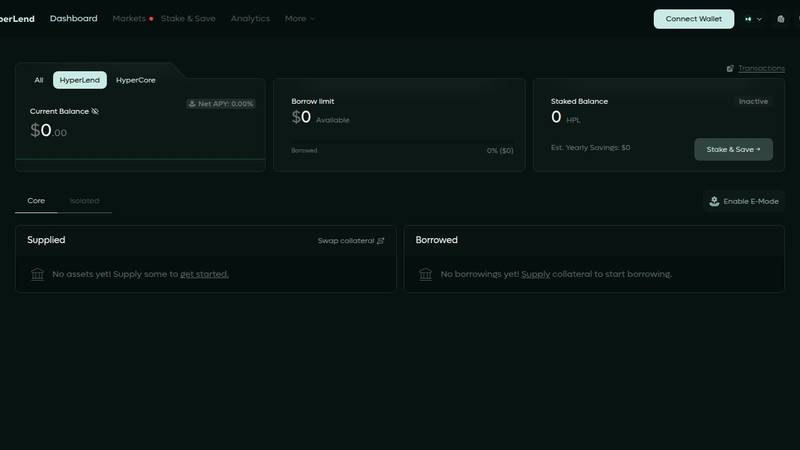
The connected dashboard has three cards. The first shows your current balance and net APY, with tabs for All, HyperLend and HyperCore. HyperCore is the trading side of Hyperliquid, so the app can show your balance on both sides in one place. The second shows your borrow limit, how much you have borrowed and your health factor. The third shows your staked HPL balance and a button to Stake & Save. Below sit two panels, Supplied and Borrowed, with tabs for Core and Isolated markets and a switch for E-Mode.
E-Mode is short for efficiency mode. It lets you borrow more against collateral that tracks the same asset, for example a staked version of HYPE against HYPE itself, because the prices move together. The danger is the same as the benefit: if the two ever separate, a loan that looked safe can fail fast. We did not switch it on.
Our wallet was empty, so both panels showed "No assets yet" and "No borrowings yet", with a link to supply. A new user is pointed to the right next step.
Markets
The Markets page is the heart of the product. A header shows total market size of about $361M, available liquidity of about $230.2M and total borrows of about $131.8M. This explains a number that confuses newcomers. DefiLlama reports about $230M locked. The $361M figure is the gross amount supplied. Both are correct, they just count different things.
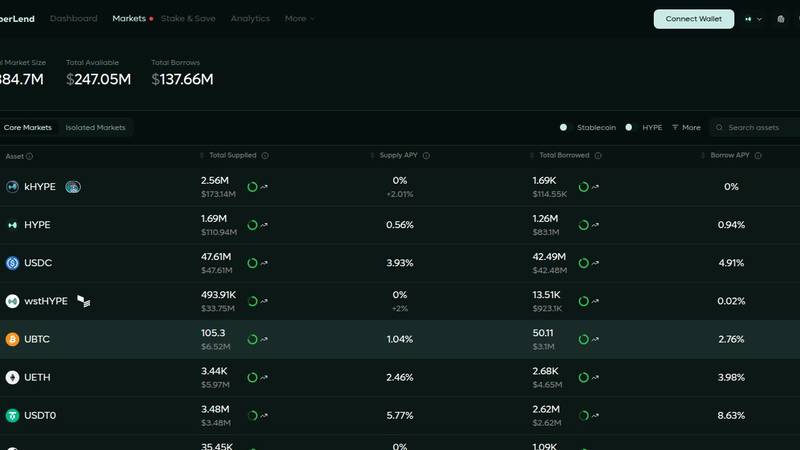
Tabs split the list into Core Markets and Isolated Markets and filter by Stablecoin, HYPE and more. Each row shows total supplied, supply APY, total borrowed, borrow APY and Supply and Borrow buttons. On the day we looked, the larger rows read as follows.
| Asset | Total supplied | Supply APY | Total borrowed | Borrow APY |
|---|---|---|---|---|
| kHYPE | $161.0M | 0 percent, plus 1.99 percent in rewards | $106K | 0 percent |
| HYPE | $103.4M | 0.56 percent | $77.4M | 0.94 percent |
| USDC | $47.3M | 3.95 percent | $42.5M | 4.92 percent |
| wstHYPE | $31.4M | 0 percent, plus 2 percent in rewards | $861K | 0.02 percent |
| UBTC | $6.4M | 1.06 percent | $3.1M | 2.78 percent |
| UETH | $5.8M | 2.52 percent | $4.6M | 4.02 percent |
| USDT0 | $3.5M | 5.82 percent | $2.7M | 8.67 percent |
Two patterns stand out. First, the staked HYPE tokens, kHYPE and wstHYPE, are large deposits that are almost never borrowed. People put them in as collateral and borrow other things against them. Second, USDC is about 90 percent borrowed. When a pool is this full, the interest rate climbs to attract more deposits and to push borrowers to repay, and a depositor who wants to withdraw may have to wait for liquidity. That is not a flaw, it is how pooled lending works, but it is worth knowing.
The long tail has oddities. USDH, a small stablecoin market with about $4.6K supplied, shows a borrow rate of 152.62 percent and a supply rate of 9.26 percent. That is a tiny pool where almost everything is borrowed, so the rate formula has pushed the price of borrowing sky high. Borrowing there is costly at that rate. Some rows are expired fixed term tokens, such as PT-kHYPE-13NOV2025, which are still listed with small leftover balances.
The supply window
Pressing Supply on USDC opens a window with an amount box, a slider, and lines for suppliable amount, supplied balance, total APY, health factor and estimated yearly earnings. With an empty wallet everything reads zero and the health factor reads 10+. The Total APY line shows the change before and after your deposit, 3.95 percent to 3.95 percent, so you see what the move does to your return. We typed an amount, but the suppliable balance was zero, so the window could not go further and we closed it. We did not test a real deposit.
Stake & Save
HyperLend's own token, HPL, has one main job in the app. If you stake it, you get a discount on the interest you pay when you borrow. The page shows your rank, your rebate, your stake, the total fees you have saved, and a "Tier Saving Projection" slider that estimates yearly savings at different stake sizes. The default example read about $243.76 a year at the top tier. Below sit staking statistics: 117,273,242 HPL staked, which the app calls 29.37 percent of circulating supply.
The docs say staking has no lockup, so you can unstake by reversing the steps. The discount only matters if you borrow, and the front page says rebates reach up to 40 percent. A lender who never borrows gets nothing from staking. We did not stake, because we held no HPL.
HyperLoop
HyperLoop is an automated strategy for people who want leverage. A loop means you deposit a token, borrow against it, buy more of the same token with the loan, deposit that, and repeat. Each turn increases your exposure and your yield, and it also increases how little price movement it takes to be liquidated. HyperLoop does the turns for you in one action. The preview we saw used wstHYPE as the yield asset and wHYPE as the debt asset, showed a base and looped APY of 1.98 percent at 1x leverage, a current price of 1.038 wstHYPE per wHYPE, and fields for health factor, liquidation price, estimated swap output, price impact and slippage.
The result at 1x leverage is the same as no loop, so the screen does not show the real risk until you raise leverage. We could not enter an amount because the wallet held nothing. Treat any looped position as one you must watch daily.
Aviya and Referrals
Aviya is HyperLend's private credit offering: fixed rate and variable rate credit facilities for approved customers. The page says KYC and KYB are required and that service is white glove, with a "Get in contact" button, so it is a sales page and not a self service product. Public users cannot borrow there. The Equities Markets entry in the menu is labeled "Coming soon".
The Referrals page offers a link and points for people you bring in. To create a code it asks you to sign a message. We declined by rule, so that page is untested beyond what it displays.
Costs
HyperLend does not charge a sign up fee or a subscription. The costs are built into the rates and the rules.
| Cost | What it is | What we saw |
|---|---|---|
| Borrow interest | Paid by borrowers, varies by asset and by how full the pool is | 4.92 percent on USDC, 8.67 percent on USDT0, 0.94 percent on HYPE |
| Supply interest | Earned by lenders, paid out of borrow interest | 3.95 percent on USDC, 0.56 percent on HYPE |
| Liquidation penalty | A discount given to the liquidator, taken from your collateral, set per asset | Not shown on the pages we opened |
| Network gas | A small fee in HYPE for each action on HyperEVM | Not measured, no transaction made |
| Swap and price impact | Charged when HyperLoop or Swap collateral trades tokens | Fields exist, no values without an amount |
| Staking | No lockup, no fee stated in the docs | Stated, not tested |
The gap between the borrow rate and the supply rate is where the protocol and its depositors earn. On USDC the gap is under one point, which is small. On HYPE it is only about a third of a point, but almost no one earns much there because the rate is low.
We could not find a single page that lists every fee, the liquidation penalty for each asset, or the share of interest the protocol keeps. The docs say the penalty is per asset, so the number depends on what you post as collateral. We did not read the contract settings. A careful user should check these numbers for the exact asset before borrowing.
A Worked Example With Round Numbers
These numbers are an illustration, not a quote, and we did not run this on the live app.
Lender. You supply 10,000 USDC at the 3.95 percent rate we saw. Over a year, if the rate held, you would earn about 395 dollars. Rates in a pool move every day, so the real figure would differ. Because the pool is about 90 percent borrowed, you should expect to wait if many people withdraw at once.
Borrower. You supply HYPE worth 10,000 dollars and borrow 4,000 USDC against it, which is a 40 percent loan to value. At the 4.92 percent borrow rate you would pay about 197 dollars a year. Your HYPE earns about 0.56 percent, which is about 56 dollars. Your net carrying cost is about 141 dollars a year, so you are paying for the right to keep your HYPE and get cash. This only makes sense if you think HYPE will rise more than that, or if you need the cash and do not want to sell.
The risk side. Suppose the lending rules let you borrow up to 80 percent of your collateral value before liquidation, a number we did not verify for HYPE. With 4,000 dollars borrowed, your collateral could fall from 10,000 dollars to 5,000 dollars before your health factor reached 1. That is a 50 percent drop. If it happens, a liquidator takes part of your HYPE at a discount, and you lose the penalty on top of the fall. The docs say that debt under 2,000 dollars, or a health factor under 0.95, can be fully liquidated, and larger positions between 0.95 and 1 only 50 percent. So a small position can be wiped out in a single step.
The HPL Token
HyperLend has a token called HPL. We checked its public data on November 26, 2026.
| Stat | Value |
|---|---|
| Price | About $0.00527 |
| Market cap | About $2.17M |
| Fully diluted value | About $5.27M |
| Circulating supply | 412.17M of 1B maximum |
| 24 hour change | Down 7.5 percent |
| 7 day change | Down 33.0 percent |
| 30 day change | Down 42.6 percent |
| All time high | $0.02355 on August 23, 2026 |
| All time low | $0.005103 on November 20, 2026 |
| 24 hour volume | About $25.6K |
| Rank | About 2,093 |
Read these numbers plainly. The token sits close to its all time low, which was set six days before our check, and it is about 78 percent below its high of three months ago. Daily trading volume is about 25 thousand dollars, which is very small. A buyer or seller of even a few thousand dollars could move the price. The market cap is about 2.17 million dollars against about 230 million dollars of deposits in the protocol, so the token is worth a tiny fraction of what the protocol holds.
The use of the token is narrow. It gives borrowing discounts through Stake & Save, and 29.37 percent of circulating supply is staked according to the app. We found no governance voting page in the app. This review does not tell anyone to buy HPL. A user of the lending market does not need to hold it.
Risks, Audits and Incident History
| Area | What we found |
|---|---|
| Audits | Pashov Audit Group (January 11, 2025), Cantina competition (January 12, 2025), Ackee Blockchain (March 24, 2025), Pashov on the oracle contracts (November 21, 2025), Nethermind (April 1, 2026), CD Security (April 25, 2026) and CD Security on the token distributor (February 16, 2026) |
| Audit reports | Published at github.com/hyperlendx/audits. We listed them and did not open the PDFs |
| Bug bounty | Paid in USDC and vested HPL, reports go to a named email address. Isolated markets count only for critical loss of funds, and denial of service attacks are out of scope |
| Monitoring | Block Analitica for risk settings, Hypernative for live threat detection, Blockworks Advisory for oversight, as stated in the docs |
| Oracles | Chainlink and RedStone, as stated in the docs |
| Hack history | The main pool does not appear on DefiLlama's hack list. The only entries with Hyperliquid in the name are about the exchange itself, not this protocol |
| Liquidation | Permissionless, so anyone can run a liquidator. A liquidator program is public on GitHub with 24 stars |
| Admin control | Not verified. We did not read who can change settings or whether there is a time delay |
Having a report is not the same as having no bugs, and the docs themselves say residual risk remains.
The risks that matter most to a user are three. Price risk is the one that costs most people money: a falling collateral price triggers a liquidation. Bad debt is the risk to lenders: if collateral falls faster than liquidators can act, the pool can be left with loans worth more than the collateral behind them, and depositors share the loss. The docs describe this openly. Small market risk is the one our screens made visible, with thin pools, rates over 150 percent and expired tokens still listed. Stay in the large, well traded markets.
There is also a concentration point. The largest deposits are staked HYPE tokens, and most of the borrowing is HYPE and USDC. A sharp fall in HYPE would hit the whole book at once. The 28 percent drop in value locked in one month shows depositors can leave fast.
How HyperLend Compares
| Question | HyperLend | Aave | Morpho |
|---|---|---|---|
| Network focus | Hyperliquid | Many chains | Many chains |
| Design | Pooled, Aave family, plus isolated markets | Pooled | Curated vaults over isolated markets |
| Native token use | Borrow discount through staking | Governance and safety module | Governance |
| Pros | Native HYPE collateral, HyperLoop, Hyperliquid balance view | Size and track record | Choice of curated risk |
| Cons | One ecosystem, falling value locked, thin token | Fewer HYPE specific markets | More moving parts |
We did not test Aave or Morpho for this review, and the table reflects their public design only. The simple point is that HyperLend is the lending market closest to the Hyperliquid ecosystem, so its value is in HYPE based collateral and in sitting next to HyperCore. If you do not hold assets on Hyperliquid, a larger multi chain market is the simpler choice.
Who Should and Should Not Use HyperLend
HyperLend suits a HYPE holder who wants to earn on idle tokens at a modest rate, or who wants to borrow a stablecoin against HYPE without selling and who will keep the loan small and watch it. It also suits a technical user who wants to read open source contracts and a public audit list before trusting a protocol.
It does not suit a beginner who plans to loop at high leverage, a user who cannot check a loan every day, or anyone tempted by the high rates in small pools. It does not suit someone who wants a token to buy, because HPL is thin and falling. It also does not suit someone who needs guaranteed instant withdrawals, because a heavily borrowed pool can run short of cash.
What We Verified and What We Did Not
| Item | Status |
|---|---|
| Public site and app load on desktop | Verified |
| Phishing warning and terms window | Verified |
| Wallet connection with MetaMask | Verified, connection only |
| Dashboard, Markets, Stake & Save, HyperLoop, Aviya, Referrals pages | Verified, viewed |
| Supply window with real values | Opened, shows zero for an empty wallet |
| Deposit, borrow, repay, withdraw | Not tested, no funds |
| Staking and unstaking HPL | Not tested, no HPL |
| HyperLoop at more than 1x leverage | Not tested |
| Referral code | Not tested, needs a signed message |
| Liquidation penalty and loan to value by asset | Not verified |
| Audit report contents | Not opened |
| Contract admin rights and time delays | Not verified |
| Value locked, token data, audit dates | Public sources, pulled on the day |
| Mobile and tablet apps | Not tested, desktop only |
Frequently Asked Questions
Is HyperLend safe? No lending protocol is risk free. HyperLend has seven listed audits, monitoring partners and no entry on DefiLlama's hack list for the main pool. It still carries smart contract risk, price risk and bad debt risk. Use money you can afford to lose and keep loans small.
Do I need to hold HPL to use it? No. You can supply and borrow without it. HPL only gives a borrowing discount when staked.
Why is the value locked different on different sites? DefiLlama reports about $230M locked. The app also shows gross supply of about $361M. Both are real, they count different things.
What is a health factor? A safety score for a loan. Above 1, the loan has not reached the liquidation threshold; at or below 1 liquidators can take part of your collateral. Keep it well above 1.
Can I lose all my collateral? In a small position, yes. The docs say debt under 2,000 dollars, or a health factor under 0.95, can be fully liquidated.
What is HyperLoop? An automated loop that borrows and re-deposits to increase exposure and yield. It increases the chance of liquidation as leverage rises.
Is there a mobile app? We did not find a separate app. The site is the product, and we tested it on desktop only.
Can I borrow from Aviya? Not as a regular user. It requires KYC and KYB and is handled through a contact form.
What happens if HyperLend is hacked? The docs describe a bug bounty and monitoring, but we found no insurance fund or compensation promise.
Quick Links
- HyperLend app
- HyperLend website
- Documentation
- Audits repository
- Bug bounty
- DefiLlama page
- HPL on CoinGecko
This article is an independent editorial review for information only. It is not financial advice. Lending and borrowing crypto can lead to total loss of funds. Figures were taken on November 26, 2026 and change quickly. Verify them before you act.
Defiliban · Oliver Benjamin

Written by
DeFi Research Writer
Oliver Benjamin is a DeFi research writer at DefiLiban, specializing in decentralized finance systems, token economics, liquidity design, and blockchain market structure. His work focuses on analyzing how DeFi protocols function beneath surface-level narratives, with particular attention to incentives, on-chain behavior, yield systems, and emerging crypto infrastructure.